
In short
A lithium battery fire is not an ordinary fuel fire. It begins inside the cell, generates its own heat and oxidiser, spreads to neighbouring cells, and can reignite hours later. That is why prevention, separation and containment matter more here than firefighting capability does.
Most premises are equipped for fires that follow a familiar pattern: something ignites, it burns, you remove the heat or the oxygen and it stops. A lithium-ion cell in thermal runaway breaks that pattern in three ways at once.
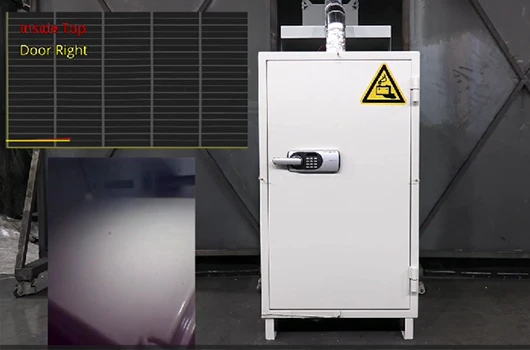
The heat comes from a chemical reaction inside a sealed metal case, so cooling it from outside is slow. The reaction releases oxygen as it decomposes, so starving it of air does not help much. And a pack contains many cells, so putting out the first one is only useful if it stops the next one going.
What actually happens inside the cell
The short version is that a lithium-ion cell stores a lot of energy in a very small space, separated by a plastic film a few tens of microns thick. Anything that compromises that separator — physical damage, a manufacturing defect, overcharging, or heat from outside — allows current to flow where it should not. That current generates heat, the heat degrades more of the separator, and the process accelerates. This is thermal runaway, and it is covered in detail on its own page.
Two practical consequences follow. First, there is usually a warning: cells vent flammable and toxic gas before they produce visible flame. Gas detection therefore gives earlier notice than a smoke detector does, which is one reason detection inside a storage cabinet is worth asking about. Second, a fire that has been extinguished may not be over — cells that were heated but did not vent can go into runaway later, which is why fire services isolate and observe packs rather than declaring them out.
What UK fire services are recording
206
e-bike and e-scooter fires in London in 2025, an average of 17 a month. Around 83% involved an e-bike — 171 fires. Two people died.
Source: London Fire Brigade, 28 January 2026.
Across the UK, the Office for Product Safety and Standards recorded 211 e-bike and e-scooter fires in 2024, with 86 injuries and eight deaths. London Fire Brigade supplied 175 of those 211 notifications, which says more about who reports consistently than about where fires happen. Treat national totals as a floor rather than a measurement.
What both datasets agree on is the shape of the problem. Fires cluster around e-bike and e-scooter packs rather than around the far larger number of phone, laptop and power tool batteries in circulation. Within that group, the recurring themes are non-original chargers, conversion kits assembled from mixed components, and packs charged in escape routes or overnight while unattended. None of that is exotic. It is why the controls that work are mostly procedural.
The controls that make the most difference
Ranked roughly by effect per pound spent:
- Control what comes onto site. Original manufacturer packs and chargers, no conversion kits, no marketplace replacements of unknown provenance. This removes the largest single cause before it arrives.
- Move charging out of escape routes and away from sleeping accommodation. Where a fire starts matters as much as whether it starts.
- Stop unattended overnight charging, or supervise it with detection that reports somewhere a person will act on it.
- Separate damaged and waste cells immediately. A swollen or dropped pack is a different problem from healthy stock and should not sit next to it. See the waste battery rules.
- Store at partial charge, cool and dry, separated from combustibles. See how to store lithium batteries.
- Contain what remains. A tested cabinet buys time and limits spread; it is the last control in the list, not the first. See battery cabinets.
The order matters because it is the reverse of how the market usually presents the problem. A cabinet is the easiest thing to buy and the last thing that helps. It is worth having — but a cabinet full of counterfeit chargers, sited in a corridor, has not addressed the risk.
Where to read further
- What causes thermal runaway — the mechanism, the four common triggers, and what off-gassing means for detection.
- Are lithium batteries safe? — the honest answer, with the incident figures behind it.
- E-bike battery fires in the UK — where the risk actually concentrates.
- UK law on storing lithium-ion batteries at work — the duties that follow from all of the above.
Frequently asked questions
How hot does a lithium battery fire get?
Reported temperatures vary widely with cell chemistry, state of charge and pack size, and figures quoted in marketing material are often taken from a single laboratory test of a single cell type. Rather than repeat a number we cannot source, the useful point is comparative: a pack in runaway produces heat faster than the surrounding structure can conduct it away, which is why containment and separation are the design goals rather than heat resistance alone.
Does a sprinkler system deal with a battery fire?
Sprinklers help with the surrounding fire and can cool a pack, which limits spread to other stock. They do not stop the reaction inside a cell that is already in runaway. Treat sprinklers as protection for the building rather than as a solution for the battery, and design storage so that a single pack failing does not reach the rest of the stock.
Are some lithium chemistries safer than others?
Cell chemistries differ in how readily they go into runaway and how much energy they release when they do — lithium iron phosphate is generally regarded as more tolerant than high-nickel chemistries, for example. That is a real difference, but it is not a licence to relax the controls: the failure mode is the same in kind, and in a mixed store you are governed by the least tolerant pack present.
What should staff do if a battery starts venting?
Raise the alarm, evacuate, and call the fire service — venting gas is the stage before flame, and it is both flammable and toxic. Do not attempt to move the pack, and do not stand over it to look. Your emergency plan should name this scenario explicitly rather than leaving staff to work it out; the HSE expects arrangements to reflect the risks actually present.