
In short
A battery storage cabinet contains a failure and buys time — it does not prevent one. Choose on tested performance, on internal capacity in watt-hours rather than on how many packs fit, and on whether you need to charge inside it. Ask for the test evidence in writing before you buy.
Cabinets are the most visible product in this market and the most often mis-sold. What a good one does is narrow but valuable: it keeps a single pack failing from reaching the rest of your stock and the building.
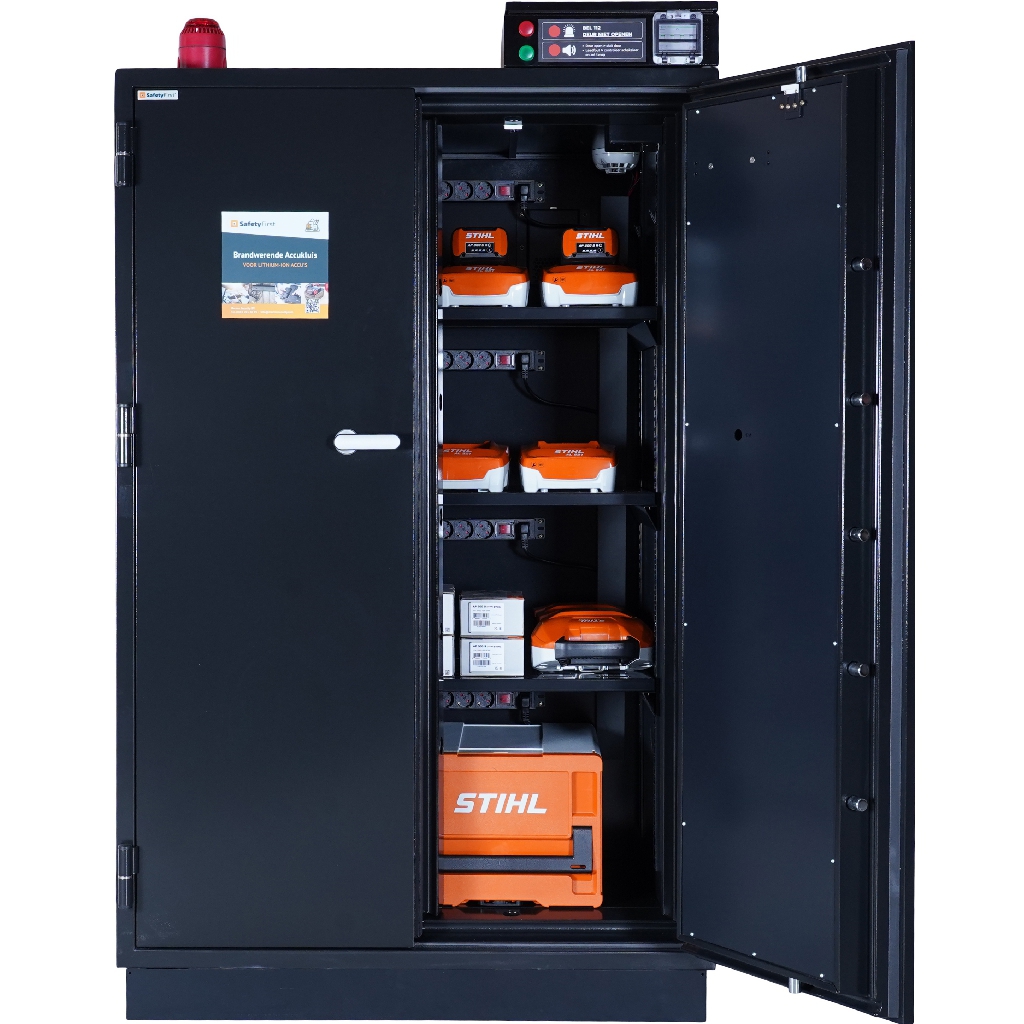
It gives people time to evacuate and the fire service time to arrive. That is worth paying for. It is not the same as making batteries safe.
What a cabinet does
- Contains. Keeps flame and hot gas inside a tested enclosure for a stated period.
- Separates. Puts a barrier between packs and combustible stock, and often between compartments inside the cabinet.
- Manages gas. Vented cells release flammable and toxic gas; a cabinet designed for batteries deals with where that goes.
- Buys time. The tested duration is time for detection, evacuation and response — not a guarantee the contents survive.
What a cabinet does not do
It does not stop a cell going into thermal runaway. It does not make a counterfeit charger safe. It does not remove the need for a risk assessment, and no UK regulation requires one — see regulations.
And it is not “fireproof”: that word implies a guarantee no tested product can give. The correct language is fire-resistant, for a stated duration, under a stated test.
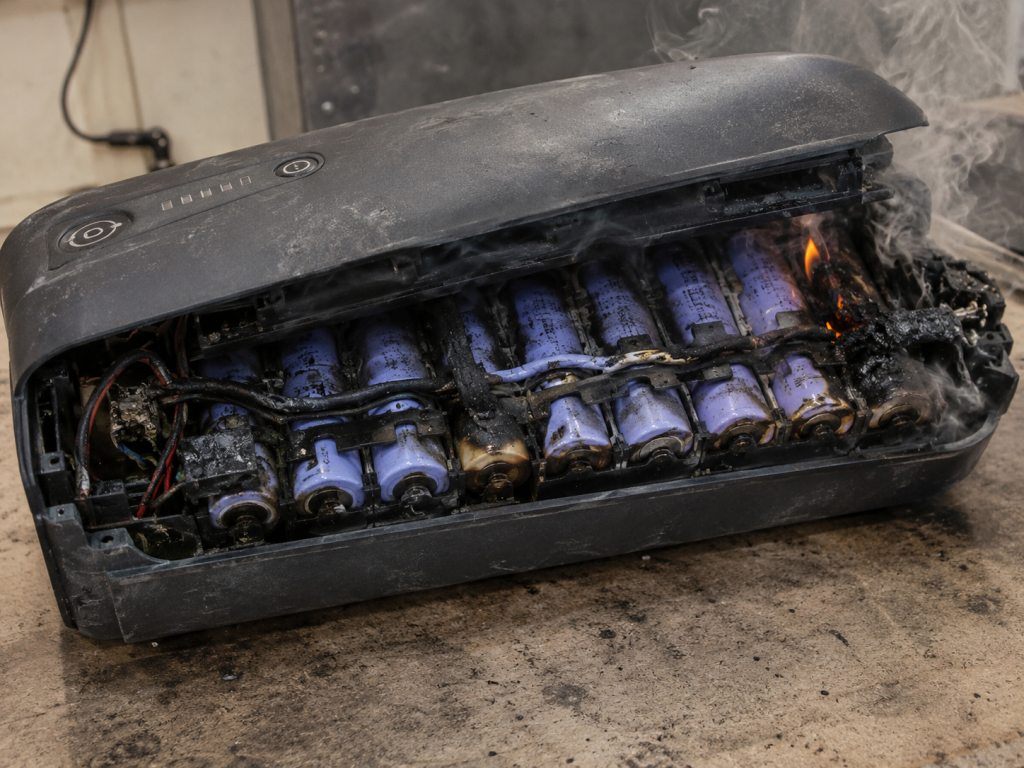
The standards quoted on datasheets
| Document | Status | Written for | How fire is applied in the test | Where the dispute lies |
|---|---|---|---|---|
| EN 14470-1 | European standard | Safety storage cabinets for flammable liquids | Fire outside the cabinet; the test measures how long the contents stay below a defined temperature rise | Widely quoted for battery cabinets because the type 15/30/60/90 classification is familiar. Its applicability to lithium batteries is disputed, because a battery fire starts inside the cabinet rather than outside it. |
| VDMA 24994 | German industry specification, not a UK or BSI standard | Storage and charging cabinets for lithium batteries | Thermal runaway initiated inside the cabinet | Addresses the failure mode that matters for batteries, but it is a trade-association specification rather than a harmonised standard, and it is not referenced in UK legislation. |
| UL 9540A | US test method | Battery energy storage systems (BESS) | Cell, module and unit-level thermal runaway propagation | Sometimes cited on portable cabinet literature. It was not written for cabinets of loose batteries, so a UL 9540A reference on a cabinet datasheet does not describe that cabinet’s performance. |
The practical test when reading a datasheet: does the claimed standard describe a fire starting inside the cabinet? If not, it is telling you how the cabinet performs in a warehouse fire, which is useful but is not the scenario you bought it for.
Sizing: watt-hours, not battery count
Two packs of identical physical size can differ several times over in energy content, and energy content is what determines how much a cabinet may have to contain. That is why cabinets are specified in watt-hours. Working out your total from the labels takes about ten minutes and is covered on capacity and watt-hours explained.
Leave headroom. Stock grows, pack sizes grow, and a cabinet loaded to its rated limit has no margin for the pallet that arrives next quarter.
Storage only, or storage and charging?
This is the decision that changes the product and the price. A charging cabinet has to handle a fault while power is applied, which brings in outlet ratings, isolation, ventilation and supervision. If you are charging anything more than occasionally, read battery charging cabinets before shortlisting.
Where to put it
Siting often matters more than specification. A well-tested cabinet in a corridor is a worse outcome than a modest one in an external store. Keep it off escape routes, away from sleeping accommodation, accessible for the fire service, and where staff will actually use it rather than leaving packs on a bench beside it because the cabinet is inconvenient.
Read next
- How to choose a battery storage cabinet — eight questions and the evidence to ask for.
- Battery charging cabinets — what changes when power is applied.
- Capacity and watt-hours explained — how to size it properly.
- Which cabinet do I need? — four questions if you would rather be pointed somewhere.
Frequently asked questions
How much does a battery storage cabinet cost?
The range is wide — from a few hundred pounds for a small storage-only unit to five figures for a large charging cabinet or a walk-in container. Price tracks internal capacity, tested duration and whether charging is included, in roughly that order. We do not publish price lists here because they date quickly; SimplySafes lists current prices for standard cabinets.
Is a fireproof battery cabinet a thing?
Not in any meaningful sense, and it is worth being careful with the word. Cabinets are tested to resist fire for a stated duration under stated conditions. “Fireproof” implies indefinite protection, which no test supports and no reputable supplier should claim. If a datasheet uses the word without a duration and a standard next to it, ask what it was tested to.
Can I store damaged batteries in the same cabinet as good ones?
No — separate them. A damaged pack has a materially higher chance of failing, and putting it next to healthy stock means its failure takes the stock with it. Damaged and waste cells need their own quarantine arrangement, and once they are waste they fall under the Waste Batteries and Accumulators Regulations 2009.
Does a cabinet need ventilation to outside?
It depends on the design and on what the manufacturer specifies, and the honest answer is that practice varies. Some cabinets are designed to be ducted externally; others manage gas internally through filtration or controlled venting. What matters is that you follow the manufacturer’s specification for that cabinet rather than a general rule, and that the arrangement is recorded in your risk assessment.